Article: How to Read a Baby Clothing Label
How to Read a Baby Clothing Label
You are holding a garment you have never worn. The photographs were lovely. The description was warm. Now turn it inside out.
Near the back of the neck there is a small strip of fabric sewn into the seam. It is easy to ignore. It is also the only part of the garment that has to be plain.
Everything else, the photographs, the packaging, the words on a website, is the brand's to shape. The label is different. In the United States, the law decides much of what it says. Once you know how to read it, you can learn a great deal in about ten seconds.
What is it made of?
The fibers are listed by percentage, with the largest share first. "100% cotton" means what it says. "60% cotton, 40% polyester" tells you something the product page may not have.
Read this first. It shapes how the fabric feels, how it breathes, and how it wears.
Where was it made?
An imported garment must say where it was made, and on a garment with a neck, that country belongs at the inside center of the neck. It is simply information. What matters is that it is stated, and easy to find.
Shopping online? The same rule reaches the screen. A product description must say whether the item is made in the U.S.A. or imported. If you can't find it, ask.
Who is responsible for it?
The label names the company behind the garment, either by name or by a registered identification number called an RN. Every RN can be looked up in the FTC's public database. A garment with no name at all deserves a question.
How do you care for it?
Care instructions must be on a permanent label that stays legible for the life of the garment. A brand that has tested its own fabric will tell you plainly how to wash it.
The detail most parents never look for
Children's products also carry what is called a tracking label: the manufacturer's or importer's name, where and when the garment was made, and the batch it came from. It must be permanent, so a hangtag does not count. It is how a specific batch can be traced if a problem is ever found.
On many garments it sits quietly on the same sewn-in label as everything else.
What a label can't tell you
A label tells you what a garment is made of and who answers for it. It can't tell you how the fabric was tested or what standards the factory follows. Those live in certificates, and every certificate has a number you can look up.
A brand proud of its standards will be glad to show you the number.
Keep this in your pocket
- Turn it inside out. Read the fibers first.
- Look for a country of origin and a company name.
- Ask where the certificate numbers are.
If you are choosing a gift, read the label before the card.
And here is ours
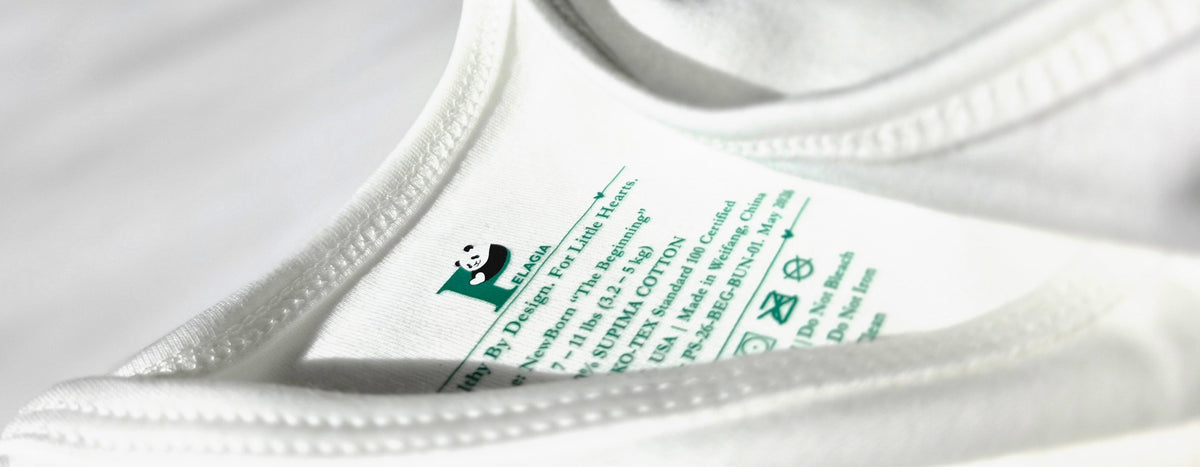
We would rather you check than trust us. Turn a Beginning Bundle piece inside out and you will find:
- The fiber: 100% SUPIMA® cotton.
- Where it was made: Made in Weifang, China. Designed in NYC, USA.
- Who answers for it: Pelagia Baby Corp.
- When and which batch: the month it was made and its batch number, printed on the label.
- How to care for it: machine wash cold, tumble dry low, no bleach, no iron, no dry cleaning.
Plainly, where you would look.
Everything we know about our own garments lives on The Standard page.